Fede Gimmel Rings: The Antique Design that Wears its Heart on its Sleeve
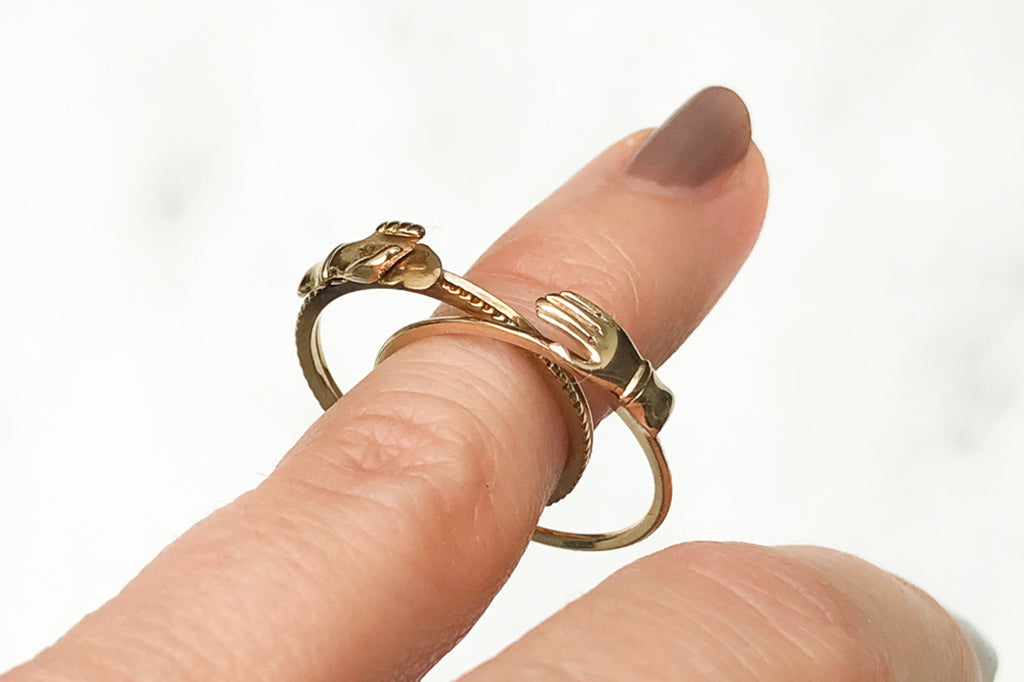
An antique piece of jewellery featuring clasped hands that rotate open, often revealing a hidden motif, I was so excited to find our first fede gimmel ring.
A popular choice for an engagement since the 16th and 17th century, while fede gimmel rings don’t usually feature a gemstone, they have enormous sentimental value and are guaranteed to always be a talking point (with the added bonus that this style is not well known so you are likely to be the only person you know who wears one).
As an alternative to a traditional engagement ring or wedding band, I can think of no design that better represents the love shared between two people. I like to think of them as a hug in a ring.
What is a fede gimmel ring?

Fede gimmel rings first rose to popularity in the 16th and 17th centuries as betrothal rings and have been a permanent fixture of antique jewellery ever since.
Representative of the union of two people, fede gimmel rings represent the coming-together of two historic jewellery traditions: the fede motif – two hands clasped together, an ancient motif that dates to Roman times – and the gimmel ring – rings comprising two or three interlocking bands.
In the past, a couple would have worn the separate bands throughout their engagement until the day of their wedding, when the groom would transfer his ring to that of his bride, uniting the two halves.
Over time, the design of fede gimmel rings evolved to incorporate three conjoined bands, bound at the base with a pin, with the centre band featuring a symbolic motif – an anchor, a cross or, most commonly, a heart.
What do the two hands on a fede gimmel ring represent?

We use our hands every day to greet each other, communicate and express ourselves, so it is little wonder that hands have been a rich source of inspiration for jewellers for centuries.
The term fede is Italian for “hands clasped in trust”, which perfectly describes the interlocking nature of the hands. Roman in origin, fede rings are believed to be among the earliest known examples of the modern-day wedding ring, with the design representing the joining of hands of a couple at a marriage ceremony, known in ancient Rome as dextrarum iunctio.
You might recognise the fede motif from traditional Celtic Claddagh rings, which features a heart between the clasped hands. Just like fede gimmel rings, Claddagh rings are powerful symbols of friendship, loyalty and love that belong to the wider European tradition of fede rings.
What is the historic symbolism of fede gimmel rings?

Fede gimmel rings are wonderfully symbolic in that they are not considered “whole” until the different parts are united. The perfect jewel to represent a couple, the different bands can be seen as separate lives coming together or, putting a more contemporary spin on things, the equality between two partners.
Our Blythe fede gimmel ring is a classic example of a three-part fede gimmel ring. Dating from the early 20th century and crafted in 16 carat yellow gold, when the clasped hands are rotated open, a double heart motif is revealed, presented on a textured gold band.
---