
Is buying a vintage engagement ring more sustainable than buying new?
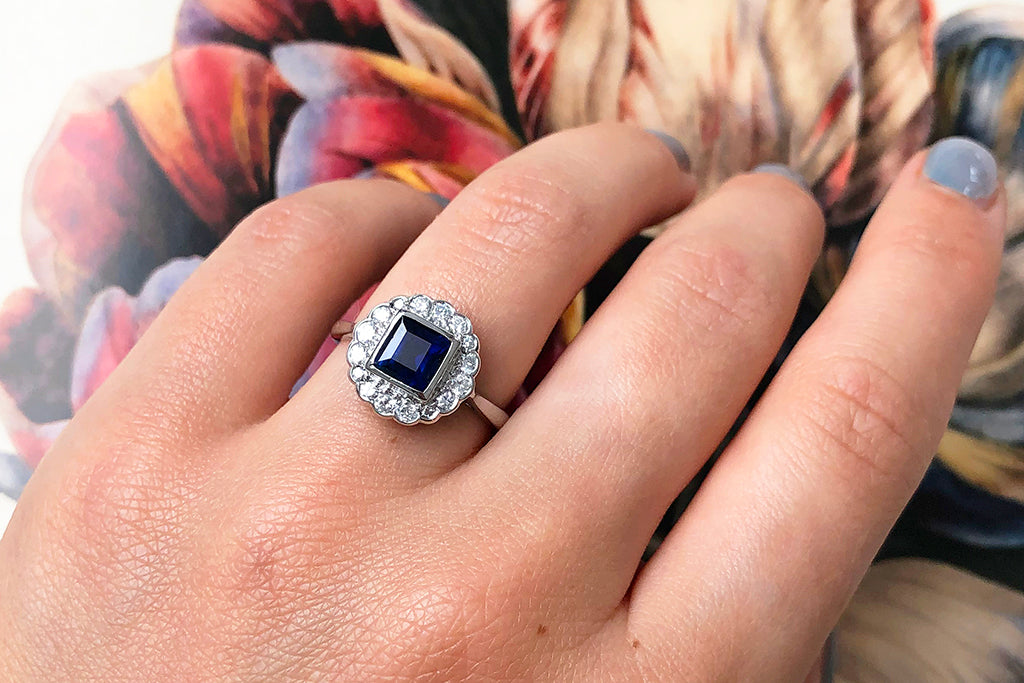
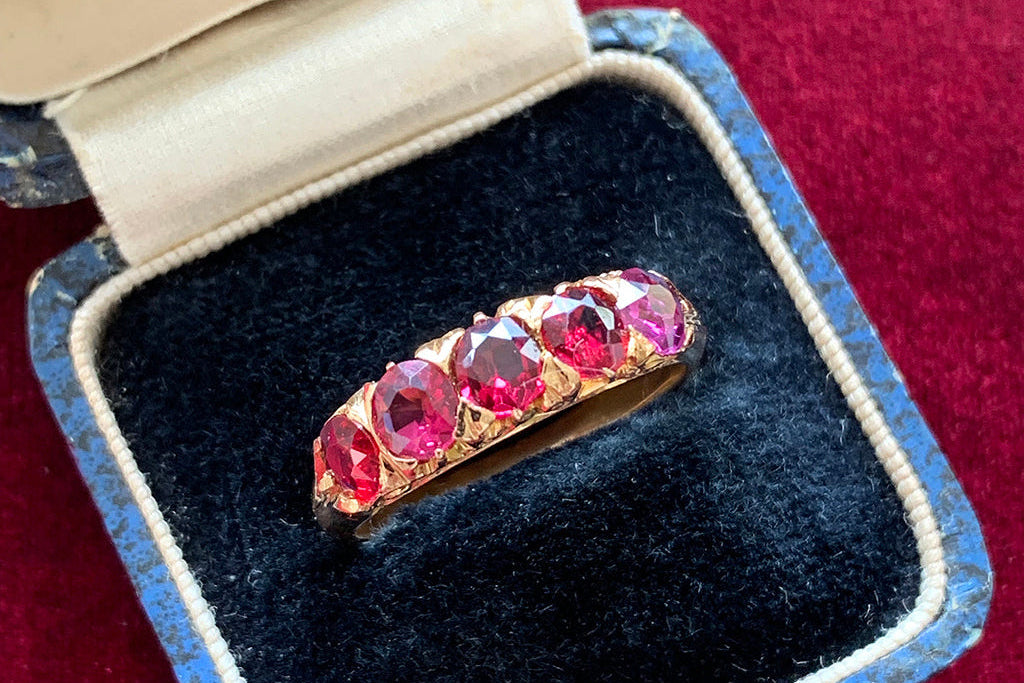
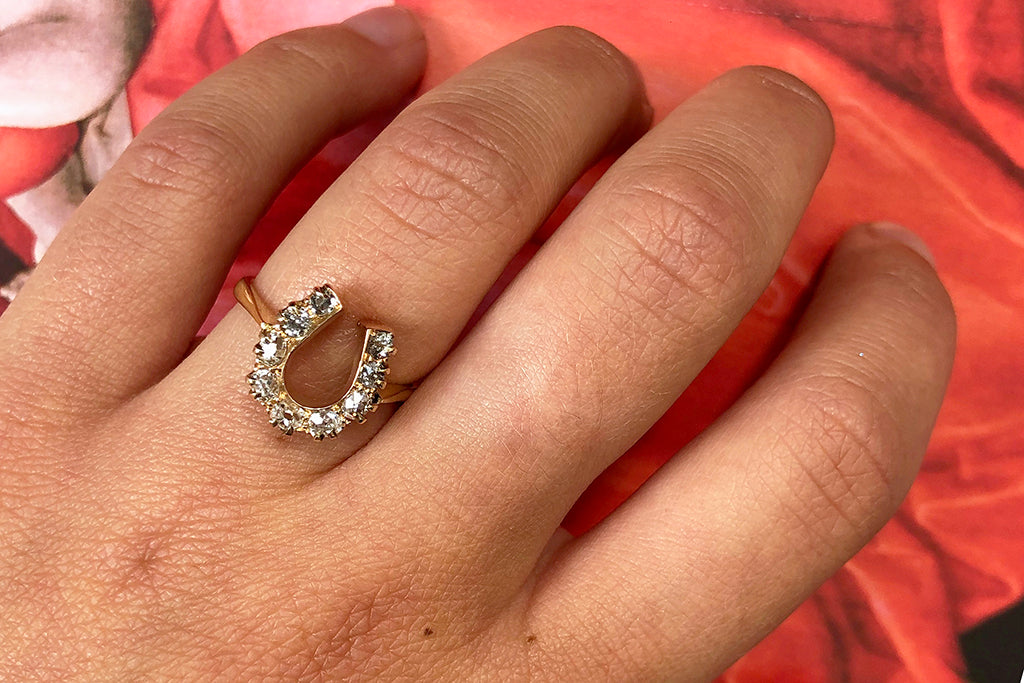
Buying a vintage engagement ring is one of the most sustainable choices you'll ever make. In its current iteration, every antique and vintage ring is conflict-free by nature, because no new mining took place for its next lease of life. The precious materials already exist; their environmental cost has already been paid. Choosing vintage removes your purchase entirely from the modern jewellery supply chain, which means it is circular by design - it cannot be held accountable for new extraction, energy consumption or carbon emissions.
As experts in ethical jewellery, we're here to equip you with the facts you deserve to make an honest purchase you can feel truly proud of.

Vintage jewellery is circularity in its fullest expression
The conventional economy operates in a straight line: extract raw materials → manufacture a product → sell it → use it → discard it. At every stage, value is consumed and waste is created.
The circular economy proposes a different model: keep materials in use at their highest possible value for as long as possible, and return them to productive use rather than waste at the end of each cycle. In jewellery terms, this means keeping rings intact and in circulation.
Recycling is not the same as circular thinking - it's the fallback. Whilst circularity is maintaining, resizing, cleaning and rehoming a vintage ring repeatedly over the years, recycling would involve breaking its material down and making it into something new. Though recycling is a highly effective method for minimising the carbon footprint of a new product, it does not compare to complete circularity when it comes to storytelling, championing historic craftsmanship and maintaining legacies.
Why no new mining matters
The problems with extraction
'No new mining' is an environmental principle which refers to a specific set of consequences - environmental and social - that are activated every time a new piece of jewellery is manufactured. Understanding those impacts is the starting point for any serious conversation about ethics.
For every single carat of rough diamond recovered, an estimated 250 tonnes of earth must be moved. The ore body is blasted and excavated - a process that consumes vast quantities of water, fuel and electricity, often leaving permanently altered landscapes when environmental restoration is not properly managed. Open-pit mines can reach depths of over 400m, covering areas the size of small towns. In cases of poor management - of which there are many throughout history - the land above them remains decimated, communities displaced.
One gold ring requires the removal of approximately 20 tonnes of ore. The cyanide heap-leach process - the dominant method for processing low-grade gold ore - introduces cyanide solutions to enormous piles of crushed rock, recovering the gold but creating toxic tailings that can leach into groundwater for decades. In some of the world's largest gold-mining regions, rivers downstream of active mines carry measurable concentrations of heavy metals.
Large-scale mining drives forced displacement globally, affecting over 100 million people. It causes physical eviction, loss of ancestral lands and economic ruin, severely degrading local ecosystems and frequently ignoring Indigenous rights.
Meanwhile, a significant proportion of the world's coloured gemstone supply (up to 80% of sapphires, rubies and emeralds) comes comes from artisanal and small-scale mining (ASM). When not managed responsibly, these operations may be run with minimal mechanisation and little regulatory oversight.
Sadly, the conditions in ASM are often dangerous and poorly compensated. In some gold-mining regions, artisanal miners use mercury amalgamation to extract gold - a process that releases toxic mercury into the surrounding soil, water, and air, with serious long-term consequences for the health of miners and nearby communities. Child labour, debt bondage and inadequate safety conditions are documented problems across ASM in multiple countries.
It's important to mention here, however, that several certification schemes - such as Fairmined - exist specifically to address these issues. They are meaningful interventions which verify that artisanal miners receive fair wages, work in safer conditions and receive premiums reinvested in their communities. If you're interested in learning more about investing in a piece of jewellery which proactively supports ASM, please reach out to our Co-Founder, ethical jewellery designer Arabel Lebrusan.

Authenticity as necessity: Our Goldsmiths' Company certificate
The entire environmental case for vintage rests on the ring being genuinely pre-loved. This is why authentication is not just a reassurance of quality, but the foundation of the ethical claim that your purchase was in no way involved in the modern supply chain.
Every ring we sell comes with a certificate of authenticity from The Goldsmiths' Company - the independent authority on precious metals and jewellery in the United Kingdom, with a history spanning back to 1327. The certificate confirms the ring's age, its metal content, and the quality of its gemstones. Independently verified, it's the equivalent of academic peer review for a vintage ring: a named, credentialled third party has examined the piece and confirmed that it is - with certainty - old!

The social and political ethics of antique jewellery
To present a nuanced case for buying a vintage engagement ring, it's important for us to acknowledge our collective histories.
Approaching antique jewellery through a decolonising lens means holding two truths at once: the beauty of extraordinary craft, and an honest reckoning with the conditions that once made it possible. It's a well-known fact that the precious materials present in some antique jewellery moved through imperial networks sustained by exploitation. A decolonising perspective doesn't ask us to reject the past wholesale, but to engage with it honestly - to use antique jewellery as a site for education and reparations. In practice, this means empowering yourself by learning the history of what you're buying and refusing the comfortable myth that antique jewellery is ethically uncomplicated.
Choosing vintage is a genuinely sustainable act: it avoids new extraction and keeps existing materials in circulation. The deeper value of that choice comes from making it with open eyes - understanding that beauty and responsibility are not opposites, and the most meaningful jewellery is worn with awareness.
About the authors

Arabel Lebrusan
This page was written by Arabel Lebrusan, co-founder of The Vintage Ring Co. and Lebrusan Studio, gemmologist, and ethical jewellery pioneer. Arabel has spent two decades working at the intersection of jewellery craft and sustainability. As a TEDx speaker and creative campaigner, she is one of the UK's most recognised voices on responsible jewellery sourcing and circular design. Her work informed the founding proposition of The Vintage Ring Co.: that the most ethical ring is one that already exists.

Claire Roberts
The Vintage Ring Co was co-founded by Claire Roberts, jewellery journalist and consumer advocate, whose writing has appeared across the UK's leading jewellery and lifestyle press. Claire brings the perspective of a buyer as well as a journalist and editor: someone who has spent years asking the jewellery industry questions, and who knows what honest answers look like.
Your questions on the ethics of vintage engagement rings, answered
Authentication enables us to distinguish a truly vintage engagement ring from one that is newly crafted in a vintage style. In other words, it draws a clear line between sustainable choice and aesthetic replica.
Every ring we sell comes with a certificate of authenticity from The Goldsmiths' Company - the independent authority on precious metals and jewellery in the United Kingdom, with a history stretching to 1327. The certificate confirms the ring's condition, the presence and quality of its precious materials, and - most importantly for the basis of a sustainability claim - its age.
On total lifecycle impact, a vintage ring leaves a smaller carbon footprint. Although completely traceable and mining-free, most lab-grown diamond require significant energy to produce. The precise carbon cost depends on the energy source used by the growing facility (with some laboratories now committed to renewable energy), but transparency varies widely across producers. Whether in recycled metal or a newly mined metal, the setting for the lab-grown diamond must also be newly manufactured. A vintage ring, on the other hand, requires no new energy for manufacture at all: it already exists. The environmental cost of making it was paid a century ago.
A vintage ring has no manufacturing carbon footprint at the point of purchase - the energy required to extract, refine and craft its materials was expended long ago and cannot be compounded. A new ring, regardless of how responsibly its materials were sourced, requires contemporary manufacturing steps: smelting, stone cutting, setting, finishing and transportation, all of which consume energy. Although the carbon footprint of certain precious materials differs greatly from others (e.g. a lab-grown diamond produced using 100% renewable energy vs. an untraceable diamond from an open-pit mine) - a vintage ring sidesteps these questions entirely.
Circularity means keeping materials and objects in use at their highest possible value for as long as possible, rather than extracting new materials and creating new waste with each generation. In jewellery, the most circular approach is keeping an entire ring intact and passing it between owners - resizing and maintaining it as needed - with no reprocessing required. Whilst recycling would involve de-setting and melting down an engagement ring to create something new, a circular approach would be to ensure it's simply passed from one generation to the next.
Partly. Recycled gold is less environmentally demanding than newly mined gold because it requires no further extraction or processing, instead honouring the material already in use above-ground.
That being said, the process of smelting (heating scrap gold to melt and separate it from impurities or other base metals) requires energy, may cause loss and can reduce metal purity. At this point, a new ring still needs to be manufactured, which requires a new supply chain. Recycled materials are absolutely a step in the right direction; but vintage is a step further.
A ring with decades of history has already proven itself as a resilient, highly-crafted object. The choice to reclaim it is an active, deliberate decision to tread gently on our planet - a decision that contributes significantly to its thoughtfulness and the sense of pride with which it can be worn. In buying a vintage engagement ring, you're not inheriting somebody else's story but starting your own with a unique, highly-crafted jewel that already knows what it means to endure.
The ethical case for buying vintage is that no new extraction takes place. In our current era of climate emergency, choosing to circulate an existing object - rather than activating new demand and a new supply chain - is a meaningful, sustainable decision. At the same time, it's important to recognise that the precious materials present in some antique jewellery once arose from exploitative imperialist networks. We cannot erase this history, but together we must learn from it. Viewing antique jewellery through a decolonising lens means empowering ourselves with knowledge of the past, treating jewellery as a site for reparations and important storytelling, and reckoning with the truth that beautiful craftsmanship and colonial legacy coexist without erasing one another. As advocates for circularity, we recognise that part of the reclaiming process is re-centring its purpose in the present day, layering it with your own legacy.